
Beer-lahai-roi: The Well in the Text and Where It Might Be


Beer-lahai-roi appears in the Book of Genesis as a named well. The short passage links it to Hagar and to a turning point in her story. Readers and students of the Bible have long asked whether a place with this name can be located on the modern map.
This article sets out a plain summary of the text, the main proposals about location, and the state of archaeological work related to this name. Where scholars express uncertainty, that uncertainty is stated. Where a claim is not directly supported by evidence, it is described as a suggestion or hypothesis. Sentences are kept short and clear to aid readers who prefer straightforward language.
The goal is not to argue for any modern claim. Instead, the piece offers a careful review of what the written sources say and how fieldwork approaches the problem of matching short place-name mentions to landscape features.
What Is Beer-lahai-roi?
The name appears in Genesis in connection with Hagar. The narrative tells that Hagar stopped at a well and encountered an angel there. The Hebrew form of the name appears as be’er lahai roi in transliteration.
In English translations the name is often given as “the well of the Living One who sees me” or a close variant. That rendering follows the phrasing used in many standard translations and commentaries. The phrase in the text records a personal reaction that is part of the short story.
The biblical note is brief. It names the place and gives a small narrative detail. It does not offer clear landmarks or distances that modern surveyors could use by themselves.
Because the passage is concise, later readers and teachers have relied on map work, ancient place lists, and comparative study to suggest where the well might have been.
from the Western Wall to Masada.
The Etymology of Beer-lahai-roi
The Hebrew words in the place name break down in a simple way. Be’er means “well.” The remaining words are connected with the idea of life and of seeing.
Scholars and commentators explore small differences of nuance in the phrase. Some discuss whether the wording reflects a theological point, while others treat it as a personal remark in the story. For general readers, the important point is that the name reflects a reaction recorded in the narrative.
Short explanations in dictionaries and Bible commentaries set out these options. Many readers find that a compact description — that the name links a well with a sense of being seen by a living presence — is enough for understanding the role of the place in the story.
Where technical language appears in specialist studies, plain summaries are also available in accessible commentaries intended for a wider audience.
Possible Locations of Beer-lahai-roi
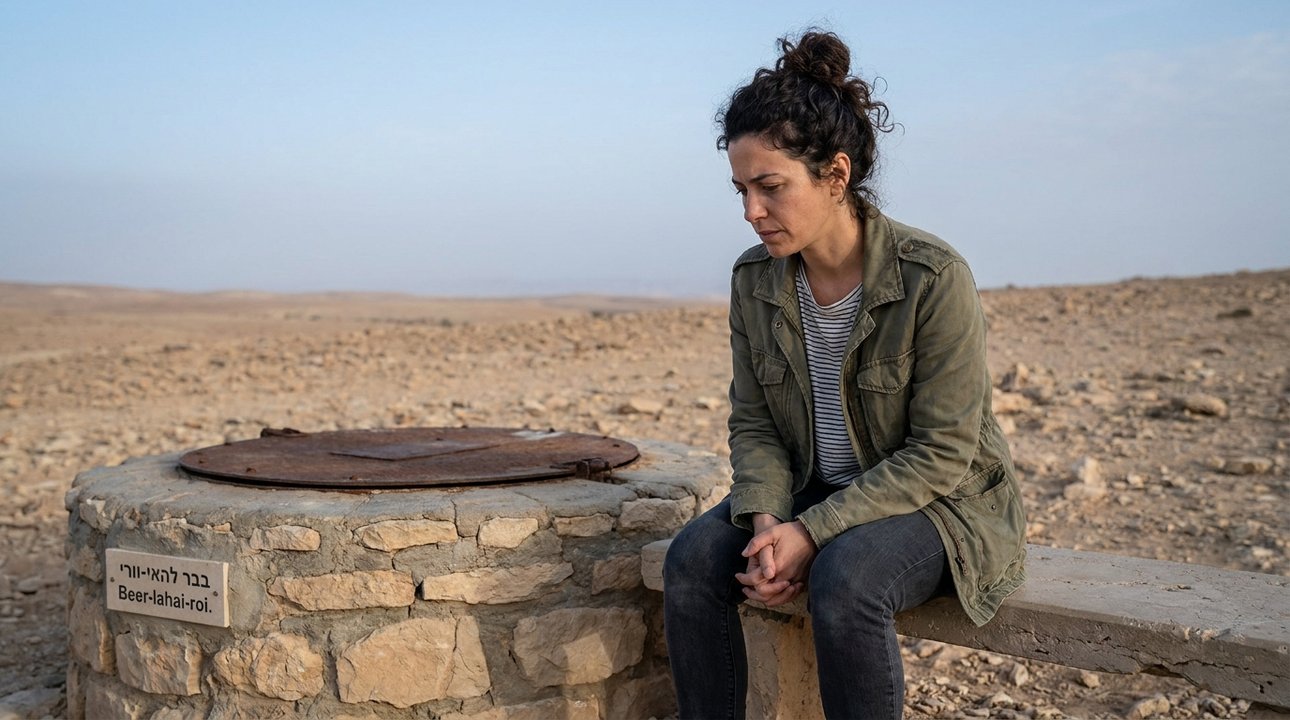
Several proposals exist for where the well might have stood. Most suggestions place it in what is today the southern part of Israel, a broad region commonly called the Negev.
Scholars who write on this subject point to features such as springs, ancient wells, and travel routes that make certain spots plausible. Ein Qedeis is one modern site that appears in some discussions. It has an old water source and visible remains in the terrain.
Other commentators remain cautious. They note that the biblical text mentions nearby names such as Kadesh and Bered. Those names help narrow the search, but experts do not agree on how to map them precisely onto modern sites.
Field researchers commonly combine the literary clues with surveys of the land. They look at the pattern of springs, the likely paths used by travelers, and the places where small settlements might have existed. Even when a place seems plausible, the link to the specific biblical name may be only probable, not certain.
Because the proposals vary, readers should treat each named candidate as a possibility rather than a fact. The absence of a single, strong marker means that several sites remain on the table in scholarly discussion.
Beer-lahai-roi in the Bible
The scriptural references to the well are short. The well features in a narrative sequence and is associated with a person and an event. Later passages place people in the general area for a time.
Because the book gives only general directions, modern readers rely on comparison with other ancient place names and with knowledge of how people moved across the region. Historians and geographers use that method when they work on many short place-name references in ancient texts.
Reference works and study guides note that these brief mentions pose a typical challenge. Scholars can sometimes narrow a probable zone. Exact pinpointing is rarely possible from the short text alone.
Readers should therefore see the biblical note as a starting point. It indicates a named stop on a route. It does not contain the kind of survey detail that would allow modern teams to identify a single, definitive site without further material evidence.
Archaeological Insights
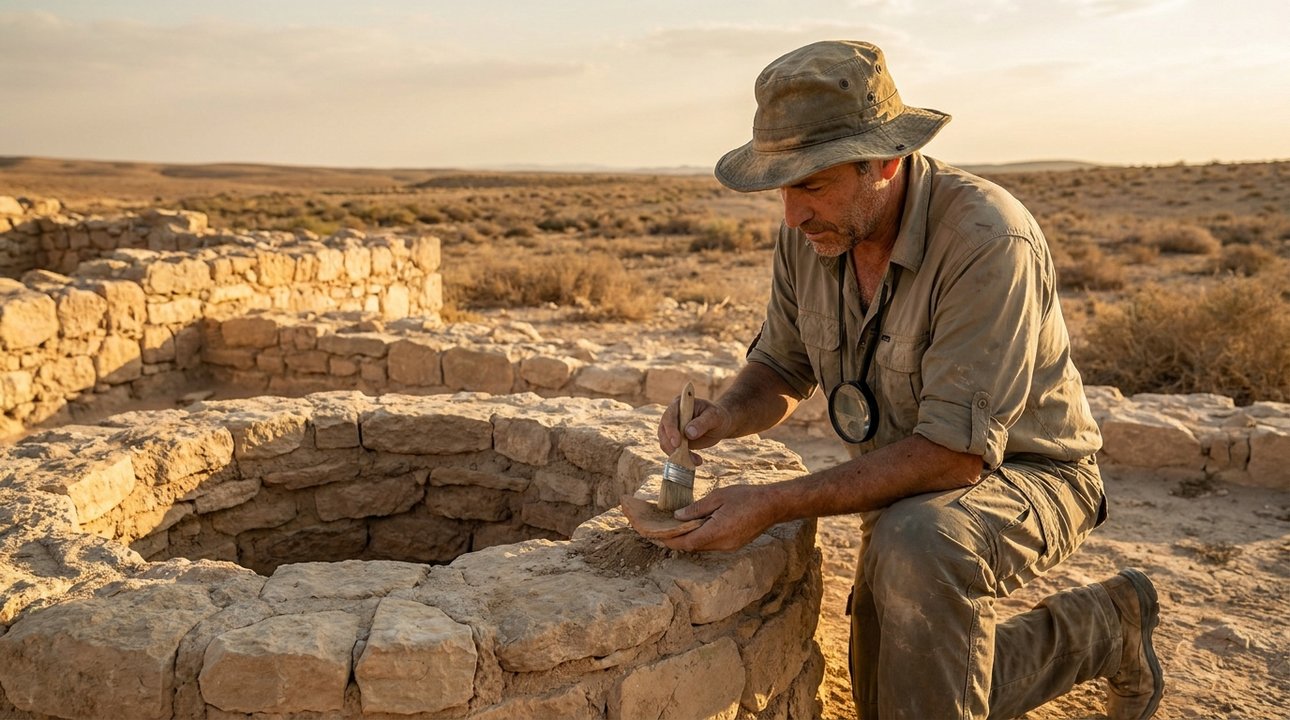
To date, archaeologists have not found an inscription or an artifact that names a site explicitly as Beer-lahai-roi. Excavations and surveys across the Negev report wells, remains of camps, and traces of past movement through the area. None of these finds includes a clear, named link to the place-name from Genesis.
Fieldwork commonly identifies features that could match general descriptions in ancient texts. For example, researchers map old watering places and look for remains that suggest past use. But many wells and springs lack markers or inscriptions that survive from antiquity.
Because of that, archaeologists use indirect evidence. They compare landscape patterns, old travel corridors, and place-name traditions preserved in later maps and documents. These methods can point to plausible areas, but they do not amount to firm proof of a named site.
When reporting on such work, careful publications make the limits of the evidence explicit. They describe which parts of an identification rest on topography, which on text, and which on material remains. This practice is common in reports on short place-name mentions in ancient literature.
Readers who consult archaeological summaries should look for where a study states the basis of any identification. Is it based on a map, on pottery finds, on a written tradition, or on a combination? Clear statements about the evidence help non-specialist readers understand how confident scholars can be.
from the Western Wall to Masada.
Research and Caution
Many statements about ancient sites are tentative. Specialists commonly use words such as “possible,” “suggested,” and “plausible” when direct evidence is missing. That careful wording signals that an identification is not firmly established.
When a modern site is proposed, researchers check several indicators. They compare the literary references, look at terrain and water sources, and study the distribution of finds in the area. Even when several indicators point the same way, differing interpretations can remain.
Scholars may disagree because they weigh different elements more heavily. One team might emphasize continuity in place-name use over centuries. Another team might give more weight to archaeological layers or to the route a caravan is likely to have taken.
Public-facing summaries often explain the reasons for disagreement. They aim to help readers understand which claims rest on solid finds and which are more speculative. For readers who prefer caution, sources that set out the evidence and the limits of interpretation are the most useful.
Setting in the Negev
The Negev covers a large, varied area. Parts are rocky and elevated. Others are sandy or flat. Access to water has shaped movement and settlement in these places for many centuries.
Wells and springs determined where people could stop during travel. They also affected where small groups could set up temporary or longer-term settlements. That practical fact explains why a well might be given a name in a travel story.
Some ancient wells remain visible in the field today. Others have been altered, filled, or lost. Natural erosion, later construction, and farming activity can all change small features that once mattered to travelers.
When modern researchers survey the Negev, they often find multiple wells clustered in valleys and at course crossings. Figuring out which, if any, corresponds to a short biblical note is a careful and time-consuming task.
For readers, a clear takeaway is that a named well from an ancient story could be any of several types of water source in the region. Without an inscription or a continuous name tradition, the match will usually remain provisional.

Conclusion
There is no modern, confirmed location that scholars agree is Beer-lahai-roi. The biblical account gives a name and a brief report, but it lacks the detailed directions or markers that would allow a definitive modern identification.
Current research places probable zones, often within the broad Negev area, but specific identifications remain speculative. Archaeology so far has not produced an inscription or other direct marker that would fix the name to a single site.
Readers who wish to learn more will find that standard reference works and clear commentaries explain the textual basis and the main modern proposals. The links listed at the start of this article point to reputable reference entries and a modern commentary piece. Those sources are suitable next steps for further reading.
If a reader wants additional references in print form, reputable study Bibles, scholarly commentaries, and regional surveys of the southern Levant provide more detail. For non-specialist audiences, introductory commentaries and concise encyclopedia entries are often the most accessible.
Why the exact location is uncertain – brief points
1) The ancient text provides limited geographic detail.
2) Place names can shift or be reused over long periods.
3) Natural and human changes can remove small features such as wells.
4) Archaeological remains without inscriptions are difficult to match to a name.
Each of these factors contributes to uncertainty. Together they explain why many short place-name references in ancient texts remain hard to locate on a modern map.
A final practical note: if a named site is important to a reader for study or travel, the best approach is to consult up-to-date reference works and to read recent field reports. Those publications explain what evidence is available and where reasonable differences of opinion remain. They also typically use careful wording — such as “possibly,” “suggested by,” and “consistent with” — when conclusions are not certain.
FAQs about Beer-lahai-roi
