Due to the war in Israel, shipments may be delayed. Thank you for standing with Israel.

Unveiling the Mystical Wheels of Ezekiel


29
Elderly Jewish man reads Torah in a historic Jerusalem synagogue.
David Pliner
Culinary & Israeli Heritage Enthusiast

The enigmatic vision of the ‘wheel within a wheel’ from the Book of Ezekiel (KJV) has fascinated scholars and mystics alike. Found in Ezekiel 1:16, this imagery is part of Jewish mystical traditions, often linked to the themes of divine movement and spiritual revelation.

Ezekiel, a prophet during the Babylonian exile in the 6th century BCE, described this vision while by the River Chebar. His descriptions are vivid, mentioning creatures and wheels full of eyes, symbolizing awareness and divine presence.

In this article, we dive into this symbolic vision, exploring its meaning and significance. The vision’s complexity invites interpretations that range from cosmic order to personal spiritual journeys.

Ezekiel’s Vision: Wheels of Mysticism

Ezekiel’s vision, described in Ezekiel 1:16 of the King James Version, introduces a striking image: ‘The appearance of the wheels and their workings was like the color of beryl, and all four had the same likeness.

‘ Each wheel was complex, embodying a ‘wheel within a wheel,’ representing an intricate design reflecting both divine creation and movement. This vivid imagery continues to spark discussion on its symbolic meanings, including ideas of interconnectedness and the multifaceted nature of divine presence.

The wheels’ design, with their ability to move in any direction, suggests the omnipresence and omniscience of divine forces. Ultimately, the vision challenges readers to consider the layers of divine interaction within the world, inviting deeper reflection on spiritual and cosmic order.

Symbolic Interpretations in Jewish Mysticism

In Jewish mysticism, the ‘wheel within a wheel’ is often associated with the Merkavah mysticism—a school of thought that meditates on the divine Chariot (Merkavah) described by Ezekiel.

This tradition dates back to the early centuries of the Common Era, focusing on the mystical experiences of heavenly ascent. The Merkavah, mentioned in Ezekiel 1:4-28, is seen as a vehicle for spiritual exploration.

Mystics envisage these wheels as part of a larger, divine mechanism that reveals deeper spiritual truths and pathways toward enlightenment. Through contemplation of such imagery, practitioners aim to achieve a more profound spiritual connection with the divine.

This process involves meditative practices and an understanding of the divine realms, often linked to the celestial beings described in the vision. The ‘wheel within a wheel’ in Jewish mysticism symbolizes a journey towards spiritual enlightenment, offering insight into divine mysteries.
The Merkavah mystics would often engage in meditation and study, seeking to understand the divine realms described in Ezekiel’s vision. The wheels, seen as symbols of divine energy, represent the constant motion and interaction of spiritual forces.

These mystics, active between the 1st and 10th centuries, believed that through deep contemplation, one could ascend spiritually. They aimed to perceive the divine chariot, or Merkavah, as described in Ezekiel 1:4-28.

This spiritual ascent was seen as a way to achieve a closer connection to divine wisdom and insight. Put simply, the ‘wheel within a wheel’ in Merkavah mysticism serves as a metaphor for the interconnectedness of divine elements, guiding practitioners on their spiritual journey.
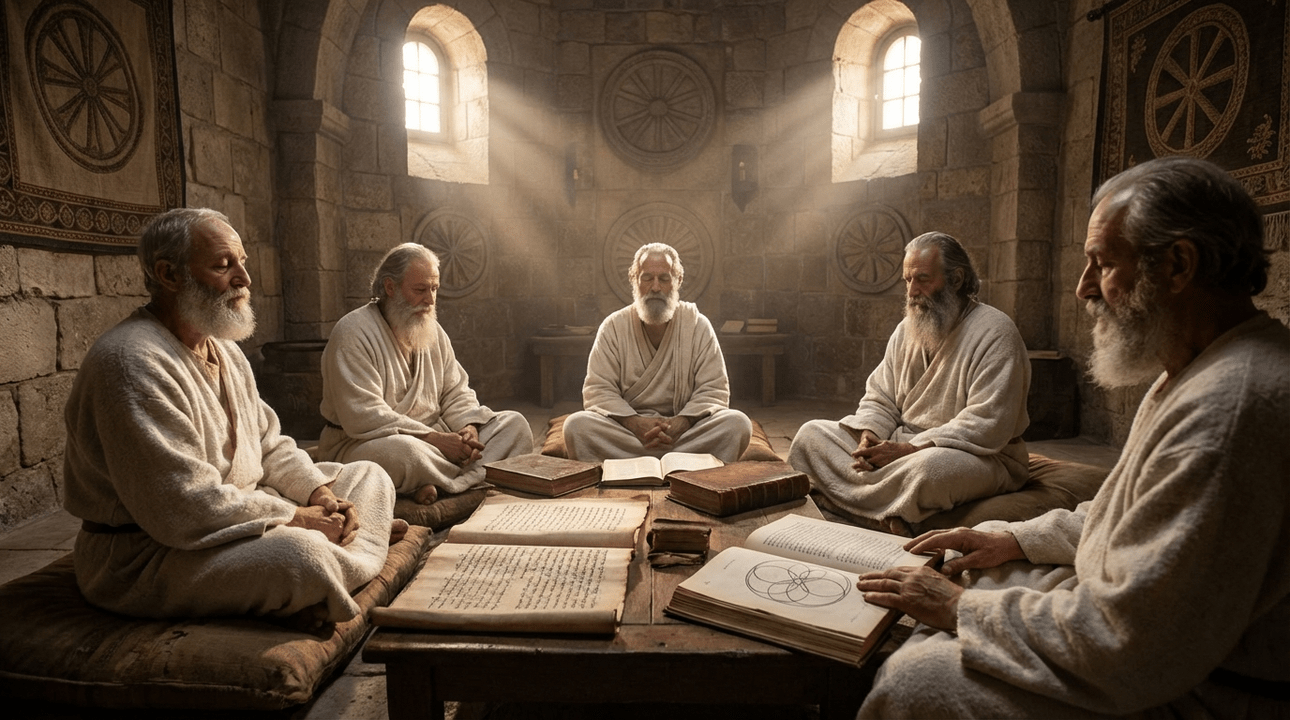
Merkavah mystics meditating around ancient scrolls in a dim Jerusalem room.

The Chariot as a Metaphor for Divine Presence

The chariot, as described in Ezekiel’s vision, serves as a powerful metaphor in Jewish thought. It symbolizes divine presence and movement, as the wheels facilitate not just physical travel but convey spiritual insights as well.

These wheels are reflective of the perpetual motion of the spiritual world, emulating how divine energy is in constant motion and transformation.

This concept further integrates into the practice of meditative states aimed at spiritual ascent, where individuals experience this divine movement personally. The chariot symbolizes the dynamic interaction between the divine and the earthly realms, offering a path for spiritual elevation.

The Role of Wheels in Kabbalistic Thought

In Kabbalah, the wheels and their movements are tied to the dynamics of the sefirot—the ten attributes through which the Infinite interacts with the universe. These sefirot include attributes like wisdom (Chokhmah) and understanding (Binah), forming a framework for divine interaction.

The vision of Ezekiel serves as an allegorical foundation that Kabbalists use to explore mystical themes. Seeing the wheels as symbols of the interconnectedness of divine forces, Kabbalists delve into the complexities of spiritual existence.

The sefirot are often depicted as a tree, known as the Tree of Life, which is central to Kabbalistic teachings and reflects the spiritual path one must navigate. Ezekiel’s vision and Kabbalistic interpretations offer a profound understanding of divine dynamics and spiritual pathways.
This enriches the understanding of an ever-expanding spiritual universe and the continuous journey of the soul towards ultimate awareness. The wheels’ motion reflects the dynamic nature of the sefirot, emphasizing the flow of divine energy throughout creation.

In Kabbalistic thought, the sefirot, such as Chesed (kindness) and Gevurah (strength), interact in a harmonious dance. Much like the wheels in Ezekiel’s vision, this illustrates the balance necessary for spiritual growth.

The interplay of these divine attributes guides individuals on their path to spiritual enlightenment. Kabbalistic interpretations of Ezekiel’s vision highlight the interconnectedness of divine attributes, offering insights into the spiritual universe and the soul’s journey.

Elderly Jewish rabbi studying Kabbalistic texts in a traditional study room.

Spiritual Lessons from Ezekiel’s Visions

Ezekiel’s vision offers several layers of spiritual lessons. The wheels, with their perpetual motion, remind believers of the cyclical nature of spiritual growth and the continuous journey toward enlightenment.

This concept is rooted in Ezekiel 1:15-21, where the wheels are described as moving in harmony with the living creatures. The detailed structure mirrors the intricacies of divine wisdom and the depth one must explore to achieve spiritual insight.

By studying such visions, individuals can find inspiration and guidance, strengthening their connections to their faith and community. The vision encourages believers to delve deeper into their spiritual practices, seeking understanding and unity with divine principles.

The vision encourages a deeper exploration of faith, highlighting the ongoing journey of spiritual development.
The vision, detailed in Ezekiel 1:15-21, illustrates how the wheels moved in harmony with the living creatures, suggesting the unity of divine will and action. This unity is a key lesson for those seeking spiritual growth.

The passage describes the wheels as having a sparkling appearance like beryl, a precious stone, emphasizing the beauty and complexity of divine creation. Their synchronized movement with the creatures highlights the seamless connection between divine purpose and earthly actions.

This imagery serves as a metaphor for the alignment between spiritual aspirations and worldly endeavors. Ezekiel’s vision teaches about the harmony and unity in spiritual journeys, encouraging believers to seek deeper understanding and connection with their faith.

Conclusion: The Lasting Impact of the Wheels Vision

Ezekiel’s ‘wheel within a wheel’ continues to captivate and inspire not only through its textual presence in the KJV Bible but also through its profound implications within Jewish mysticism.

The vision, found in Ezekiel 1:16, stands as a testament to the richness of biblical imagery and its ability to convey complex spiritual themes.

Today, it remains a vital part of scriptural study and mystical contemplation, drawing connections to universal themes of spiritual exploration and revelation. Artists and writers have drawn upon this imagery to explore themes of divine order and cosmic balance, reflecting its enduring influence.

This imagery has been used in various forms of art and literature, symbolizing the complexity and interconnectedness of the universe. Ezekiel’s vision serves as a powerful symbol of spiritual exploration, continuing to inspire both religious and cultural contexts.
This vision, described in detail in Ezekiel 1:4-28, has been a subject of study for centuries, influencing not only religious thought but also art and literature. Its imagery of wheels and creatures has been interpreted as a representation of divine order and the complexity of the universe.

In the Renaissance, artists like Raphael depicted these themes. Blending biblical narratives with artistic expression, these works expanded the vision’s impact beyond religious texts. This artistic exploration has kept the vision relevant in both spiritual and cultural contexts.

Ezekiel’s vision of the ‘wheel within a wheel’ serves as a powerful symbol of divine complexity and spiritual exploration, remaining relevant in both religious and cultural contexts.

Elderly Jewish man reading ancient scroll in sunlit olive grove.

Sources:: Ezekiel 1 MSG;KJV - Wheels Within Wheels, Like a Gyroscope - Bible Gateway, The Vision of Ezekiel - For an informed reading of Ezekiel 1:1–28, 3:12 - Chabad.org, Ezekiel's Vision | My Jewish Learning, Merkavah Mysticism: The Chariot and the Chamber | My Jewish Learning, Chariots Ascending - The Zohar meditates on the creatures of the Supernal Chariot. - Chabad.org, Sacred Objects: Wheels | Sefaria
Frequently Asked Questions about Ezekiel’s Vision
Last update: 1 October 2023 10:00
Understanding the Wheels