
Understanding the 7 Plagues in the Bible

The story of the plagues in the Book of Exodus vividly illustrates the struggle for freedom and deliverance. These events are central to Jewish memory and are commemorated during the Passover celebration. While often referred to as ten, this article will focus on the commonly known seven plagues.
We will unfold their stories and meanings in the context of the struggle between Pharaoh and the Israelites, exploring how each one challenged the societal and religious structures of ancient Egypt.
These events serve as a powerful narrative of liberation, illustrating the lengths to which the Israelites had to go to secure their freedom. As we examine each one, we’ll see how they not only punished the Egyptians but also reinforced the Israelites’ faith in their eventual deliverance.
The account is detailed in the book of Exodus, chapters 7 through 12. This story is not just about ancient events; it continues to inspire and remind us of the enduring power of faith and resilience in the face of adversity.
The narrative is a testament to the strength and perseverance of the human spirit.
from the Western Wall to Masada.
The First Plague: Waters Turned to Blood
The first disaster that struck Egypt was the turning of the Nile into blood, vividly described in Exodus 7:14-24. The Nile, central to Egyptian life and spirituality, became a scene of devastation as fish died and the water became undrinkable, affecting the entire nation.
This event symbolized a direct challenge to Pharaoh’s control over his land, undermining his authority and the perceived power of the Egyptian gods, particularly the god Hapi, who was associated with the Nile.
The transformation of the river marked the beginning of a series of events that would lead to the Israelites’ liberation.
The transformation of the Nile was a significant blow to the Egyptians, who relied on the river for agriculture, transportation, and daily sustenance. The sudden change turned their source of life into a source of death, causing widespread panic and desperation.
As described in Exodus 7:14-24, the Nile turning to blood killed the fish and made the water undrinkable. This event marked the beginning of a series of divine acts that would systematically dismantle the Egyptians’ confidence in their gods and their leader, Pharaoh.
The god Hapi, associated with the Nile’s fertility, was unable to restore the river, challenging the foundation of Egyptian spiritual and daily life.
The Second Plague: A Swarm of Frogs
The second calamity involved a vast multitude of frogs invading all of Egypt, as described in Exodus 8:1-15. Frogs entered homes, kitchens, and even Pharaoh’s palace, symbolizing irritation and disruption of daily life.
The Egyptians worshipped a frog-headed deity, Heqet, making this event especially symbolic. It served as a direct challenge to the Egyptian pantheon, showing that their gods could not prevent the chaos unleashed upon the land, further eroding the authority of Pharaoh.
The frogs’ pervasive presence was a constant reminder of the divine power at work against the Egyptians.
Frogs were everywhere, in beds, ovens, and kneading bowls, making everyday tasks nearly impossible. This overwhelming presence of frogs was not just a nuisance but a direct affront to the Egyptian belief system.
The frogs, described in Exodus 8:1-15, infiltrated every corner of Egyptian life, even entering Pharaoh’s palace. The inability of Pharaoh’s magicians to remove the frogs highlighted the impotence of the Egyptian gods and the futility of relying on them for protection and order.
The goddess Heqet, associated with fertility and depicted with a frog’s head, was powerless to stop this invasion, further undermining the Egyptians’ religious confidence.
The Third Plague: Lice Infestation
In the third event, the dust of Egypt was transformed into lice, as detailed in Exodus 8:16-19. This occurrence covered both humans and animals in lice, highlighting the Egyptian magicians’ inability to replicate such a miracle.
Here, nature itself seemed to turn against the Egyptians, showing the limits of human power. This was the first time the magicians acknowledged it as ‘the finger of God,’ marking a turning point in the narrative where divine power was unmistakably evident.
The recognition by the magicians further isolated Pharaoh and emphasized the divine origin of these events.
The lice infestation was a severe nuisance that affected the cleanliness and comfort of everyday life. The magicians’ failure to replicate this occurrence demonstrated their limitations and the supremacy of the divine force at work.
In Exodus 8:16-19, the dust of the earth became lice, covering both people and animals. This acknowledgment by the magicians was significant, as it marked the first time that even the Egyptian court recognized the divine origin of these events, further isolating Pharaoh in his resistance.
Their admission that this was ‘the finger of God’ was a pivotal moment in the narrative, highlighting the undeniable power at play.
The Fourth Plague: Swarms of Flies
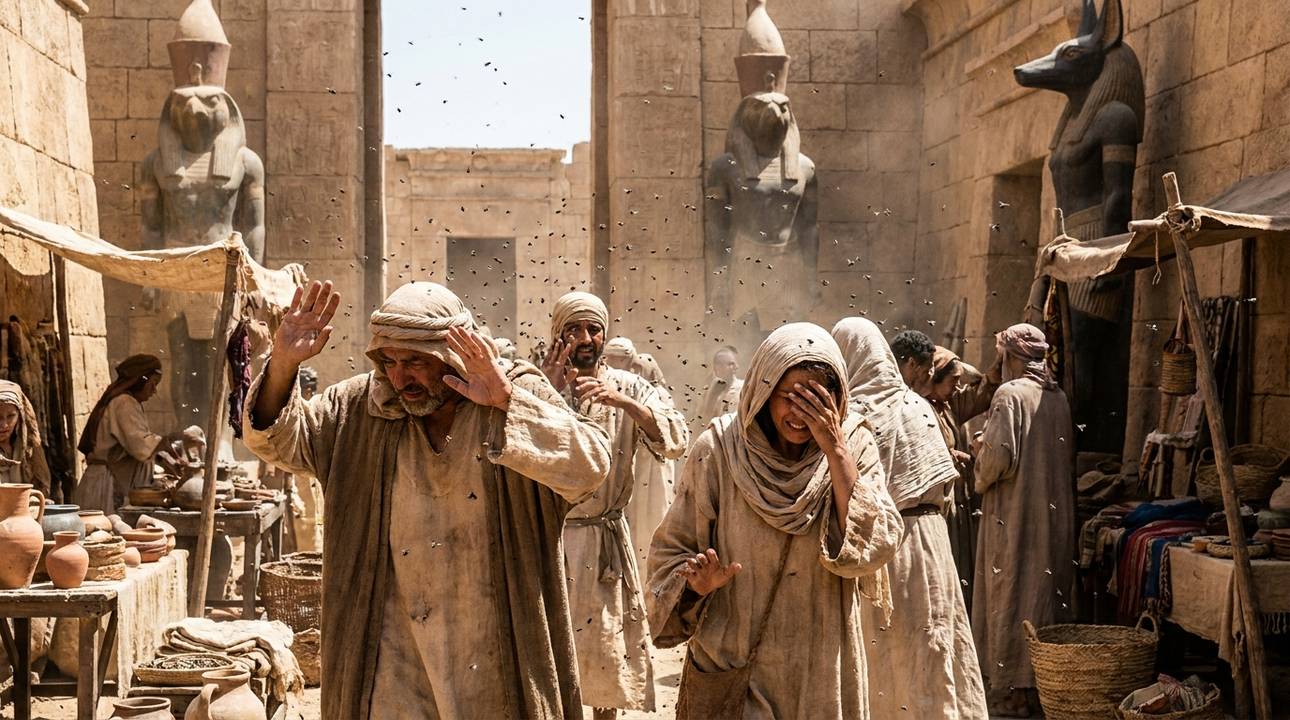
The fourth event involved swarms of flies that tormented the Egyptians. Described in Exodus 8:20-32, flies infested every part of the land, causing chaos. This particular occurrence did not affect the Israelites, highlighting divine protection.
Pharaoh began to negotiate, demonstrating how these events pressured him. This pestilent infestation emphasized the power imbalance between Pharaoh and the divine forces at play, as the Egyptians suffered while the Israelites were spared.
The distinction between the two groups was a clear indication of the selective nature of these events.
The flies were everywhere, in homes, on people, and even in Pharaoh’s palace. This relentless invasion disrupted daily life and symbolized a breakdown in the Egyptian social order. The flies were a direct challenge to the Egyptian deities, who were powerless to stop the onslaught.
Exodus 8:20-32 describes how the land was ruined by the swarms. Pharaoh’s initial attempts to bargain with Moses showed his desperation, as he offered to let the Israelites sacrifice within Egypt, a proposal Moses rejected.
This negotiation highlighted the pressure Pharaoh felt under the weight of these events, as he struggled to maintain control.
from the Western Wall to Masada.
The Fifth Plague: Death of Livestock
The fifth plague, described in Exodus 9:1-7, caused the death of Egyptian livestock, including horses, donkeys, camels, cattle, and sheep. This event struck a severe blow to Egypt’s economy, disrupting agricultural activities and trade.
Remarkably, the Israelites’ animals were spared, showcasing divine favor and protection. The loss of livestock was not only an economic disaster but also a cultural blow, as it affected the daily lives and religious practices of the Egyptians, who revered certain animals.
The Egyptians relied heavily on their livestock for transportation, farming, and religious rituals. The sudden loss of these animals crippled their society and highlighted the vulnerability of their way of life.
Exodus 9:1-7 details how the livestock of the Egyptians perished while the Israelites’ animals remained unharmed.
This occurrence reinforced the message that the divine power behind these events was not only capable of destruction but also selective in its protection, sparing the Israelites and their possessions.
This selective protection emphasized the distinction between the Egyptians and the Israelites, furthering the narrative of liberation.
The Sixth Plague: Boils on People and Animals
The sixth plague inflicted painful boils on Egyptians and their animals. Exodus 9:8-12 narrates the event where Moses and Aaron tossed soot that became boils. This was a direct strike on physical health, infiltrating the personal and intimate spheres.
It further demoralized Egyptian society and hardened Pharaoh’s heart even more. It highlighted the futility of Egyptian deities in providing healing, as their priests and magicians were powerless to alleviate the suffering.
The boils served as a physical manifestation of the spiritual and societal breakdown occurring in Egypt.
This event was particularly humiliating for the Egyptian priests, who prided themselves on their purity and cleanliness. The boils rendered them unclean and unable to perform their religious duties, further showcasing the superiority of the divine power behind these occurrences.
Exodus 9:8-12 describes how Moses and Aaron took soot from a kiln and tossed it into the air, causing boils to break out on people and animals. The physical affliction was a stark reminder of the vulnerability of human strength and the limitations of earthly power in the face of divine will.
The priests, unable to perform their rituals, represented the failure of the Egyptian religious system to protect its people.
The Seventh Plague: Devastating Hailstorm
The seventh event unleashed a deadly hailstorm, combining fire and ice, as described in Exodus 9:13-35. This severe weather event devastated crops and properties, impressing fear among the Egyptians. The storm marked a more forceful demonstration against Pharaoh’s stubbornness.
Egyptian gods of weather were powerless, revealing their limitations and the supremacy of divine intervention. This occurrence served as a stark reminder of the vulnerability of human constructs against nature’s fury.
The destruction caused by the hailstorm further weakened Egypt’s economy and morale, highlighting the futility of resisting the divine will.
Significance of the Plagues in Exodus
These events proved divine power over Egyptian gods, reflecting a cosmic contest. They symbolized liberation from oppression and enforced collective memory. Each occurrence targeted a specific aspect of Egyptian life, from prosperity to health.
The narrative ultimately served as a pivot for Israel’s freedom. It continues to be a cornerstone of Jewish cultural identity and faith, reminding generations of the journey from slavery to freedom and the enduring strength of their heritage.
These occurrences are a testament to the resilience and faith of the Israelites in the face of overwhelming adversity.
These occurrences were not random acts; each one was a calculated strike against Egyptian society and its pantheon. For instance, the Nile turning to blood challenged the god Hapi, while the frogs mocked the goddess Heqet. This ongoing struggle highlighted the impotence of Egyptian deities.
These events also served as a moral lesson, demonstrating that oppression and injustice would not go unanswered, and that liberation was a divine right. Each occurrence systematically dismantled the Egyptians’ belief in their gods, reinforcing the message of liberation for the Israelites.
Conclusion: The Lessons of the Plagues
The narrative teaches resilience and faith through its vivid account. Each occurrence, from the water turning to blood to the death of the firstborn, illustrates how adversity can transform into freedom through divine intervention, as seen in Exodus 7-12.
Even today, these events underscore themes of justice and redemption. They remind us of the enduring power of faith and collective identity, serving as a testament to the strength of the human spirit in the face of overwhelming odds.
The story’s lessons continue to inspire generations, offering hope and guidance in times of struggle.
Understanding the Biblical Plagues
