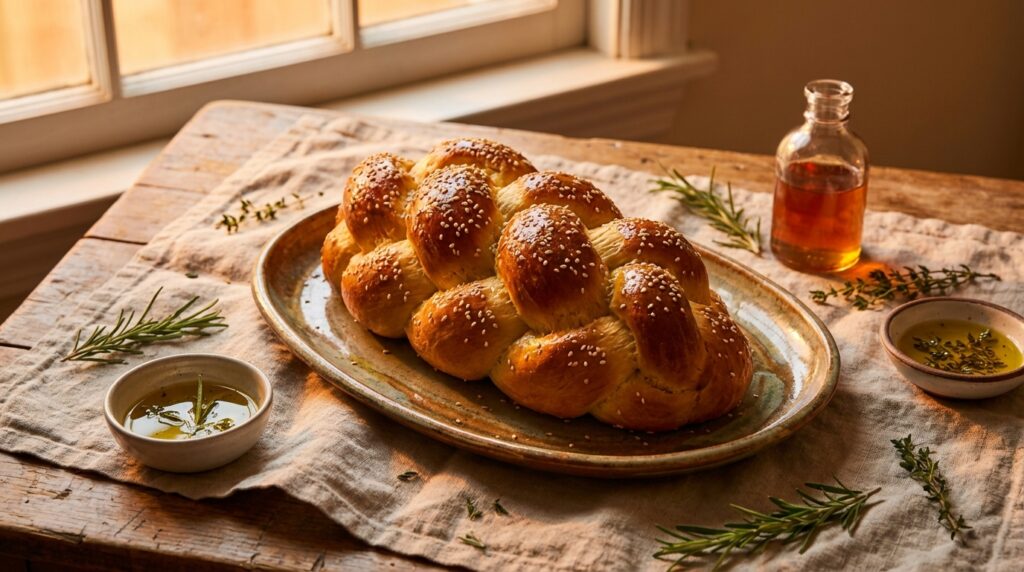
Celebrate Shavuot with Traditional Challah

A Festive Bread for a Joyous Occasion
Explore the heartwarming tradition of baking Shavuot Challah, a bread that brings families together during this special holiday.
Image illustrating:Celebrate Shavuot with Traditional Challah
2
David Pliner
Culinary & Israeli Heritage Enthusiast
Discover the rich tradition of Shavuot Challah, a delightful bread perfect for festive celebrations.

Health Benefits

  • Rich in carbohydrates for energy.
  • Contains protein from eggs.
  • Honey adds natural sweetness.

Ingredients

All-purpose flour
4 cups
Warm water
1 cup
Active dry yeast
2 1/4 teaspoons
Honey
1/4 cup
Eggs
3
Salt
1 teaspoon
Vegetable oil
1/4 cup
Raisins (optional)
1/2 cup

Chef's Tips

For a glossy finish, brush the challah with egg wash before baking. To add a unique twist, sprinkle with a mix of sesame and poppy seeds.

Instructions

  • 1
    1
    Prepare the Yeast Mixture
    In a small bowl, combine warm water and honey. Sprinkle yeast over the mixture and let it sit for about 5 minutes until foamy.
  • 2
    2
    Mix the Dough
    In a large bowl, whisk together flour and salt. Make a well in the center and add the yeast mixture, eggs, and oil. Stir until a dough forms.
  • 3
    3
    Knead the Dough
    Transfer the dough to a floured surface and knead for about 10 minutes until smooth and elastic. If using raisins, knead them into the dough.
  • 4
    4
    First Rise
    Place the dough in a greased bowl, cover with a damp cloth, and let it rise in a warm place for about 1 hour, or until doubled in size.
  • 5
    5
    Shape the Challah
    Punch down the dough and divide it into three equal parts. Roll each part into a long rope and braid them together to form the challah.
  • 6
    6
    Second Rise
    Place the braided challah on a baking sheet lined with parchment paper. Cover and let it rise for another 30 minutes.
  • 7
    7
    Preheat and Bake
    Preheat the oven to 350°F (175°C). Brush the challah with egg wash and sprinkle with seeds if desired. Bake for 25-30 minutes until golden brown.
  • 8
    8
    Cool and Serve
    Remove the challah from the oven and let it cool on a wire rack. Slice and serve warm or at room temperature.

The Story Behind Shavuot Challah

Shavuot Challah is a cherished tradition in Jewish homes.

The origins of challah date back to ancient times when it was a staple in Jewish households. Over the years, it has become synonymous with Jewish festivals, especially Shavuot, where it symbolizes abundance and gratitude. The braided design is not just for aesthetics; it represents unity and continuity.
Shavuot, known as the Feast of Weeks, is a time of joy and celebration. It marks the giving of the Torah at Mount Sinai and is one of the three pilgrimage festivals in Judaism. During this time, families come together to share meals, and challah plays a central role on the dining table, embodying the spirit of the holiday.
The tradition of baking challah for Shavuot has been passed down through generations. Each family may have its unique recipe, but the essence remains the same: a sweet, soft bread that brings people together. The act of braiding the dough is often a communal activity, involving family members of all ages.

Baking challah is a meaningful way to connect with heritage.

In many Jewish communities, challah baking is more than just a culinary task; it’s a spiritual experience. The process of kneading and shaping the dough is often accompanied by songs and stories, creating a warm and inviting atmosphere. This ritual not only strengthens family bonds but also reinforces cultural identity.
Challah is traditionally made with simple ingredients like flour, water, yeast, and eggs. However, for Shavuot, it is common to add sweet elements like honey or raisins to enhance its festive nature. These additions symbolize the sweetness of the Torah and the joy of the holiday.
The finished challah is often adorned with sesame or poppy seeds, which are said to represent the manna that fell from heaven during the Israelites’ journey in the desert. This adds a layer of historical significance to the bread, making it a profound part of the Shavuot celebration.

Challah’s symbolism extends beyond its taste and appearance.

The braided strands of challah are often interpreted as representing love, truth, and peace. These values are central to the teachings of the Torah and are celebrated during Shavuot. Sharing challah with loved ones is a way to express these sentiments and foster a sense of community and togetherness.
In modern times, challah has gained popularity beyond Jewish communities. Its delicious taste and beautiful appearance make it a favorite at various celebrations and gatherings. Many people enjoy experimenting with different flavors and shapes, adding their personal touch to this traditional bread.
Despite its widespread popularity, the essence of challah remains deeply rooted in Jewish tradition. It serves as a reminder of the past, a celebration of the present, and a hope for the future. Each loaf tells a story of resilience, faith, and unity, making it a cherished part of Jewish culture.

Related Recipes

FAQ

Can I substitute honey in the recipe?
Yes, you can substitute honey with maple syrup or agave nectar for a different flavor profile.
How should I store leftover challah?
Store the challah in an airtight container at room temperature for up to three days.
Can I freeze the challah?
Yes, you can freeze the challah for up to three months. Thaw at room temperature before serving.